Wednesday, 4 January 2012

Ekegusii Encyclopedia Project:

This page is dedicated to the Ekegusii Encyclopedia Project , instigated and directed by Mr. Kennedy Momanyi Bosire of Mombasa.
.....PLEASE NOTE OUR NEW URL.....
www.suttonelms.org.uk/ekegusii2.html
The Abagusii are one of the ethnic tribes which comprise the Republic of Kenya and speak Bantu language, Ekegusii, an endangered language. We believe Ekegusii should be protected and preserved.


The new Dictionary / Encyclopedia is online. See

ONLINE EKEGUSII ENCYCLOPEDIA.
    Mr.K.M.Bosire, Ekegusii Encyclopedic Project Director
    Kennedy Bosire is an Ekegusii language activist who played a key role in InField 2008 at the University of California as an instructor in Field Methods for the Ekegusii workshop and a presenter in the Models of Language Documentation and Revitalization workshop (both coordinated by Carol Genetti).
"Language documentation is for the future and targeting the youth must be our strong point".

Ekegusii Encyclopedic Project is a community based organisation registered under the Ministry of Culture and Social Services in the Republic of Kenya.

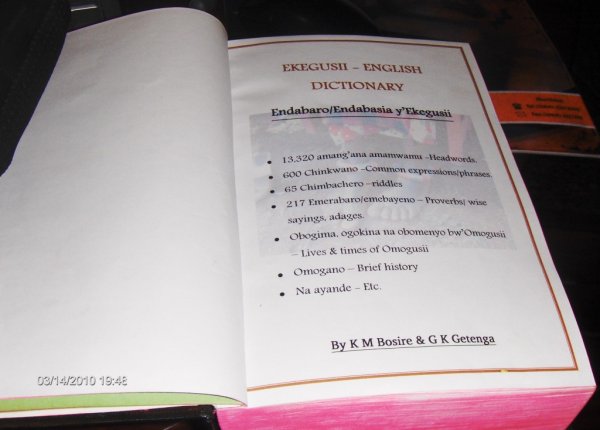
We are in the final stages of preparing the paper copies of a detailed Ekegusii Dictionary for publication.

Meanwhile, if you can help the language preservation project in any way, particularly with fundraising, please contact us:

infonm@ekegusiiencyclopedia.com


Kenya's library services have allowed us to be publishers of our works and have granted us ISBN numbers.

Next actions are:

  • Get confirmation from the editors that we are ready for printing.

  • Identify and engage a printer.

  • Raise funds for the printing.

  • Promote the work.

  • Launch and distribute.

    The title page of this magnificent dictionary is shown here; click on the thumbnail for the detail.


    There is also an invitation to attend language training and workshops / seminars at the University of Oregon, USA. This time we (Ekegusii Encyclopedia Project) have been selected to present papers in conjunction with others from Australia, the Americas and possibly Europe.

    Kennedy M. Bosire, Project Director
    Mrs. Gladys Kwamboka Machogu, Project Coordinator

    .......................................................................................................................ARCHIVE,2006

    Our Objectives:

    1. To raise awareness among the Abagusii community of the state and level of endangerment of the language.

    2. To encourage its learning and promotion.

    3. To document, preserve and archive it.

    4. To help establish an organisation to initiate, spearhead and oversee the language's dynamism especially in technology, communication, medicine and the environment.

    5. To facilitate community support for families, providing care for people living with HIV/AIDS and orphans and to ensure programme sustainability through income generating activities.

    Modalities:

    1. Generate Encyclopedic materials in the form of dictionaries, references and other literature.

    2. Establish cultural community centres.

    3. Establish sustainable learning programs within the community, and

    4. Train personnel to sustain the gains and propogate them for posterity.

    5. Organise HIV-AIDS outreach programs: home based care, counselling, feeding and education.

    Older news is shown further down. This page will shortly be updated. The older news will remain online, accessible via the ARCHIVE link above.

  • What is the Yaaku?

    The Yaaku (often Mukogodo-Maasai) are a people living in the Mukogodo forest west of Mount Kenya, a division of the Laikipia District of Rift Valley Province, Kenya. Former hunter-gatherers and bee-keepers, the Yaaku have assimilated to the pastoralist culture of the Maasai in the first half of the twentieth century, although there is still some occasional bee-keeping going on. The reason for this transition is mostly one of social prestige. The Maasai look down upon hunter-gatherer peoples, calling them Dorobo ('the ones without cattle'), and many Yaaku consider the Maasai culture to be superior. As a result of the assimilation the Yaaku almost completely gave up their Cushitic language Yaaku for the Eastern Nilotic Maasai language between 1925 and 1936. The Maasai variant they speak nowadays is called Mukogodo-Maasai. Old Yaaku words are still found in some parts of the bee-keeping vocabulary, for example:
    • sɪka — 'honey' (cf. Maasai en-aisho)
    • íno — 'Greater Honeyguide (Indicator indicator)' (compare Maasai n-cɛshɔrɔ-î)
    • kantála — 'wooden honey container (about 60 cm)'
    A revivalist movement has been rising among the Yaaku in recent years, aiming to strengthen the Yaaku identity. In early 2005, Maarten Mous, Hans Stoks and Matthijs Blonk visited Doldol on the invitation of a special Yaaku committee, to determine whether there is enough knowledge of Yaaku left among the people to revive the language. This visit has shown there are few truly fluent Yaaku speakers left, all very old: two women called Roteti and Yaponay, respectively, and a man called Legunai. The latter two are both of the Terito age set, which means that they must be around a hundred years old. Knowledge of vocabulary is much wider spread in the community. Full language revival is improbable because of the scarcity of fluent speakers, but one of the possibilities for a partial revival is to use Yaaku vocabulary in the framework of Maasai grammar, a strategy that is analoguous to the making of Mbugu, a mixed language of the Usambara mountains in Tanzania.

    Ethnic groups in Kenya

    The Nandi is a Kenyan ethnic group or tribe living in the highland areas of the Nandi Hills in Rift Valley Province; they form a sub-group of the Kalenjin. Before British colonization, they were sedentary cattle-herders, sometimes also practicing agriculture; their settlements were more or less evenly distributed rather than being grouped into villages. Like other Nilotic peoples, they were noted warriors. They traditionally practice circumcision of both sexes as a rite of initiation into adulthood. Boys' circumcision festivals took place about every 7 and a half years, and boys circumcised at the same time are considered to belong to the same age set; like other Nilotic groups, these age sets were given names from a limited fixed cycle. About four years after this festival, the previous generation officially handed over defense of the country to the newly circumcised youths. Girls' circumcision, excising the clitoris, took place in preparation for marriage. They traditionally worship a supreme deity, Asis (literally "Sun"), as well as venerating the spirits of ancestors. They were divided into a variety of clans, each with a particular " totem" animal which its members could not eat. Their land is divided into six "counties" (emet): Wareng in the north, Masop in the east, Soiin/Pelkut in the south, Aldai and Chesumei in the west, and Em-gwen in the center. The Orkoiyot, or medicine man, was traditionally acknowledged as an overall leader. The Orgoiyot led not only in spiritual matters but also during wars, as evidenced during the war between the British colonials building the railway and the Nandi warriors. The leader at the time was Koitalel Arap Samoei who was killed by a British soldier. The Nandi have a reputation for courage and swiftness (the latter statistically proven.) In precolonial times, they also enjoyed a fearsome reputation as fighters; Arab slave-traders and ivory-traders took care to avoid the area, and the few that dared attempt to traverse it were killed. ...more on Wikipedia about "Nandi people"
    The Oromo are an African ethnic group found in Ethiopia and to a lesser extent Kenya. They are the largest single ethnic group in Ethiopia, numbering around 24 million or approximately 32% of the population. Their native language is the Oromo language, or Afan Oromo. ...more on Wikipedia about "Oromo"
    The Pokomo are an ethnic group of Kenya, who are predominantly agriculturalists living along the Tana River in the Tana River District. They speak a language of the Niger-Congo group. ...more on Wikipedia about "Pokomo"


    The Pokot people (commonly spelled Pökoot, in older literature Suk) live in the West Pokot and Baringo districts of Kenya and in the eastern borderland of Uganda, east of the Karimojong area. They speak Pökoot, a Kalenjin language of the Southern Nilotic language family. A 1994 figure of SIL puts the total number of Pokot speakers at 264 000, while the only little more recent Schladt (1997:40) gives the more conservative estimate of 150 000 people, presumably based on the figures found in Rottland (1982:26) who puts the number at slightly more than 115 000. ...more on Wikipedia about "Pokot"
    The Rendille are an African ethnic group of the Kaisut Desert of Kenya. They refer to themselves as "the holders of the stick of God". ...more on Wikipedia about "Rendille"
    The Samburu are an ethnic tribe in north central Kenya related to the Maasai. They are semi-nomadic pastoralists who mainly herd cattle but also keep sheep, goats and camels. The name they use for themselves is "Lokop" or "Loikop," a term which may have a variety of meanings which Samburu themselves do not agree on. Many assert that it refers to them as "owners of the land" ("lo" refers to ownership, "nkop" is land)though others present a very different interpretation of the term. The Samburu speak the Samburu language. ...more on Wikipedia about "Samburu"
    The Sirikwa were an ethnic group in the Turkana area of Kenya, sometimes identified with the Oropom or the Kalenjin. ...more on Wikipedia about "Sirikwa"
    The Somalis are an ethnic group indigenous to the Horn of Africa. These people are of African heritage. They speak the Somali language, which is part of the Afroasiatic language family (subgroup: Cushitic) and is thus related to the Oromo, Sidamo, Afar, Agaw, and Beja languages and also Arabic language. There are between 10 and 20 million ethnic Somalis, principally concentrated in Somalia (over 8 million), Ethiopia (3-5 million), Djibouti (250,000), northeast Kenya (240,000) and an unknown but large number living in non-east African countries, primarily the United States and northern Europe. ...more on Wikipedia about "Somali people"
    The Suba are a people in Kenya who speak the Suba language. Their population is estimated at under 30,000, making them one of the country's smallest tribes. They migrated to Kenya from Uganda and settled on the two Lake Victoria islands of Rusinga and Mfangano, and are believed to be the last tribe to have settled in Kenya. They were influenced by the Luo, who live on the mainland. There are also people in Tanzania (Tarime District, Mara Region) who call themselves Suba, but it is unclear as to whether or not they are part of the same ethnic group. ...more on Wikipedia about "Suba"
    The Terik people are a Kalenjin tribe inhabiting parts of the Kakamega and Nandi Districts of western Kenya, numbering about 120 000 people. They live wedged in between the Nandi, Luo and Luhya (Luyia) peoples. Among the Luo they are known as nyangóóri, but to the Terik, this is a derogatory term. The Terik call themselves Terikeek; in their usage, 'Terik' refers to language, land, and culture. ...more on Wikipedia about "Terik"
    The Tugen are a branch of the Kalenjin community and they occupy the districts of Baringo and Koibatek in Rift Valley, Kenya. Daniel Arap Moi, the second president of Kenya (1978–2002) was from the Tugen branch. The Tugen people speak the Tugen language. ...more on Wikipedia about "Tugen"
    The Turkana are a Nilotic people of Kenya, numbering about 340,000. They inhabit Turkanaland in northwest Kenya, a dry and hot region bordering Lake Turkana in the east. South of them live the Pokot (Pökoot), Rendille, and Samburu. The language of the Turkana, an Eastern Nilotic language, is also called Turkana; their own name for it is Ng'aturk(w)ana. ...more on Wikipedia about "Turkana people"
    The Yaaku (often Mukogodo-Maasai) are a people living in the Mukogodo forest west of Mount Kenya, a division of the Laikipia District of Rift Valley Province, Kenya. Former hunter-gatherers and bee-keepers, the Yaaku have assimilated to the pastoralist culture of the Maasai in the first half of the twentieth century, although there is still some occasional bee-keeping going on. The reason for this transition is mostly one of social prestige. The Maasai look down upon hunter-gatherer peoples, calling them Dorobo ('the ones without cattle'), and many Yaaku consider the Maasai culture to be superior. As a result of the assimilation the Yaaku almost completely gave up their Cushitic language Yaaku for the Eastern Nilotic Maasai language between 1925 and 1936. The Maasai variant they speak nowadays is called Mukogodo-Maasai. Old Yaaku words are still found in some parts of the bee-keeping vocabulary, for example: ...more on Wikipedia about "Yaaku"

    Special Rapporteur on a Kenyan Safari

    The Special Rapporteur on the situation of human rights and fundamental freedoms of indigenous people visited Kenya from 4 to 14 December 2006 at the invitation of the Government of Kenya. The Special Rapporteur's report (A/HRC/4/32/Add.3) submitted to the 4th session of the Human Rights Council in March 2007 brings to the fore several disturbing issues about the conditions of the indigenous peoples of Kenya.
    Some of the key findings of the Special Rapporteur are summarized below: 
    I. Lack of legal recognition
    There are 42 tribes who are recognized as indigenous peoples in Kenya. They are either the pastoralist communities such as Endorois, Borana, Gabra, Maasai, Pokot, Samburu, Turkana, and Somali or the hunter-gatherer communities such as Awer (Boni), Ogiek, Sengwer and Yaaku. But the 1989 national census had not recognized many smaller pastoralist and hunter-gatherer communities such as El Molo, Watta, Munyayaya, Yakuu, and other small groups such as Sabaot and Terik as separate tribes.
    Lack of legal recognition resulted in further social, political and economic marginalization of the excluded hunter-gatherer and pastoralist communities.  They do not figure in the national scheme of things.
    The indigenous peoples do not have proportionate political representation at the national or provincial levels or participation in local decision-making processes.
    II. Rights to land and resources
    The present policy of sanctity of the title provides that first registration of land title cannot be challenged in court regardless of fraud or mistake committed at the time of taking over the land from the first owner. This has led to widespread displacement of indigenous peoples from their lands in the Rift Valley and Kajiado district. The pastoralists in the north and north-eastern regions are also facing potential threats of displacement.
    Although the Kenya Government terms the indigenous and minority groups as "minorities", "marginalized" or "vulnerable communities", historical injustices committed against them have not been rectified in independent Kenya. The Maasai indigenous peoples lost one third of their territory through coercive treaties in 1904 and 1911 imposed by the colonial regime. But these lands have not been restored to the Maasais. As of today, 75 per cent of the occupied land still remains in hands of the European owners in Laikipia District.
    III. Displacement due to wildlife conservation policies
    Wildlife conservation and preservation of natural parks are high on the political agenda of the government as wildlife, national parks and game reserves have been major tourist attractions. The government earns 10 per cent of the GDP as direct and indirect revenues from wildlife tourism.
    Protected areas cover over 3.5 million hectares or 6 per cent of Kenya's total land area. Majority of wildlife parks and reserves and protected forests are situated in the arid and semi-arid lands (ASALs) areas, which are predominantly inhabited by the pastoralists and hunter-gatherers, and this has been devastating for the livelihood of the indigenous peoples. The indigenous communities do not participate in the management of the parks and reserves. Neither are they benefited from the revenue earned from eco-tourism.
    Instead, they have been separated from the wildlife and forests and evicted from their traditional habitats as a result of creation of protected areas.
    In unprotected forest areas, settlement schemes, illegal logging and charcoal production have resulted in the loss of the traditional habitat of the forest dwelling indigenous peoples and the indigenous hunter-gatherers.
    The Ogiek indigenous peoples were evicted from their traditional habitat as soon as the Mau Forest was gazetted as a National Forest in 1974 without their prior and informed consent or consultation. They have been denied compensation. Since then they have been prevented from hunting or collecting bee honey from the forest. On the other hand, illegal commercial logging continued to take place in the Mau Forest.
    IV. Continued human rights violations by the security forces
    The security forces have been responsible for arbitrary detention, harassment, torture, rape and extrajudicial killings.
    Impunity continued. The security forces who were responsible for killing of hundreds of Degodia Somali at Wagalla in Wajir in 1984 have not been identified or brought to justice.
    V. Deplorable socio-economic conditions
    The Special Rapporteur mentions that the Kenya UNDP Human Development Report 2001 indicates that the Human Development Index declined from 0.531 in 1990 to 0.514 in 1999. There have been fall in life expectancy, per capita income and school enrolment and the rise in infant mortality and poverty. But as the Special Rapporteur has pointed out, "The Human Development Report does not provide disaggregated data about indigenous people."
    Most indigenous peoples live in the arid and semi-arid lands (ASALs) which make up more than 80 per cent of the total land mass of Kenya. More than 25 per cent of the country's population lives in these ASAL areas. The socio-economic conditions of the indigenous peoples are pathetic. Over 60 per cent of the population of the ASAL areas, which are predominantly inhabited by pastoralist sand hunter-gatherers, lives below the poverty line against national average of 50 per cent.
    The Special Rapporteur has stated that causes of poverty among the indigenous peoples are "unequal distribution of land and the lack of access to productive resources; the lack of access to and distribution of social services; ineffective development programmes; and the lack of basic infrastructure and marketing opportunities".
    The indigenous peoples have been disproportionately denied access to primary education. An estimated 1.7 million children are out of school, out of which marginalized pastoralist communities are the majority. The literacy level for Maasai in Kajiado and Somali in Mandera is only 3 per cent compared with a national average of 79.3 per cent.
    Majority indigenous peoples also do not have access to primary health care, due to "distance, lack of transport and essential supplies, and high costs". Although child labour is high among the indigenous communities, this problem has not received government attention.
    VI. Violence against indigenous women
    Indigenous women face discrimination and systematic abuse from outside and within own communities. Although, female genital mutilation (FGM) was banned in 2001, this is still practised widely among numerous indigenous communities such as the Maasai, Samburu, Somali and Pokot in the name of culture. 34 per cent of women undergo FGM at national level but the percentage in North Eastern Province is as high as 99 per cent.
    Customary laws also discriminate against the women. Many indigenous women are denied access to property rights.
    Indigenous women also face violence from the security forces, including rape particularly during ethnic conflicts. The police do not always register complaints of rape.
    VII. Non-ratification of ILO convention No. 169
    Kenya has not ratified ILO Convention No. 169 on Indigenous and Tribal Peoples in Independent Countries.  This is a huge set back for the indigenous communities.
    The Constitution of Kenya has not recognized the rights of indigenous pastoralist and hunter-gatherer communities and the government does not have any policy or institution to deal directly with indigenous issues.
    Some key drawbacks of the Special Rapporteur's report
    The Special Rapporteur has missed a few key issues of deep concern on the enjoyment of human rights by the indigenous peoples.
    Yaaku people

    The Yiaku (often Yaaku, or incorrectly Mukogodo-Maasai) are a people living in the Mukogodo forest west of Mount Kenya, a division of the Laikipia District of Rift Valley Province, Kenya. Former hunter-gatherers and bee-keepers, the Yaaku have partly assimilated to the pastoralist culture of the Maasai in the first half of the twentieth century, although some still keep bees. The reason for this transition is mostly one of social prestige. The Maasai look down upon hunter-gatherer peoples, calling them Dorobo ('the ones without cattle'), and many Yaaku for a certain time considered the Maasai culture superior to their own. As a result of this decision the Yaaku almost completely gave up their Cushitic language Yaaku for the Eastern Nilotic Maasai language between 1925 and 1936. The Maasai variant they speak nowadays is called Mukogodo-Maasai. Old Yaaku words are still found in some parts of the bee-keeping vocabulary, for example:
    • [sɪka] — 'honey' (cf. Maasai en-aisho)
    • [íno] — 'Greater Honeyguide (Indicator indicator)' (compare Maasai n-cɛshɔrɔ-î)
    • [kantála] — 'wooden honey container (about 60 cm)'
    A revivalist movement has been rising among the Yaaku in recent years, aiming to strengthen the Yaaku identity. In early 2005, Maarten Mous, Hans Stoks and Matthijs Blonk visited Doldol on the invitation of a special Yaaku committee, to determine whether there is enough knowledge of Yaaku left among the people to revive the language. This visit has shown there are few truly fluent Yaaku speakers left, all very old: two women called Roteti and Yaponay, respectively, and a man called Legunai. The latter two are both of the Terito age set, which means that they must be around a hundred years old. Knowledge of vocabulary is much wider spread in the community. Full language revival is improbable because of the scarcity of fluent speakers, but one of the possibilities for a partial revival is to use Yaaku vocabulary in the framework of Maasai grammar, a strategy that is analoguous to the making of Mbugu, a mixed language of the Usambara mountains in Tanzania.

    THE YAAKU:LOST PEOPLE OF KENYA

    Their language is officially classed as extinct – and fewer than 10 people in the world still speak it.
    Their homes were caves in the forest, but they have long been abandoned.

    Their traditional bride price was the hind leg of a giraffe – and a ban on hunting giraffe meant many of their young men never married nor raised a family.

    They are the Yaaku, possibly the smallest remaining community in Kenya, and one it is feared will soon be extinct. They are not even officially recognised in the Kenyan census.

    The Yaaku look like the Samburu, speak mostly Maa and live in the Mukogodo Forest of Laikipia.

    Their astonishing story is told in Lifestyle, today.

    -This is a very sad story. can you fathom how the youth of this community umiad coz they couldn't grab a steak of a giraffe and get themselves some wallop? Consider yourself lucky?

    Kenya Yaaku people fighting for their language.

    An « ultra minor minority », as they call themselves humorously, the Yaaku people are only 4,000 or 5,000. Most significantly though, only a dozen of them can still speak their language, a Cushitic language of the Afroasiatic family. What’s more, these ultimate mother tongue Yaaku speakers are all aged, and their command of the language can be relative. Needless to mention that the Yaaku language is endangered… UNESCO actually considers it extinct!
    Settled in Mukogodo forest, in central Kenya, the Yaaku people used to live off hunting, picking, and the harvest of wild bee honey. But the arrival of the Maasai at the end of the 19th century changed everything: they were warriors of repute, rich with their herds, and they despised the Yaaku, less numbered and considered inferior because they had no sense of ownership. Gradual acculturation followed: the Yaaku started to farm livestock, left the forest, and turned to Maasai costumes, lifestyle… and language.
    © Yaaku Cultural Museum
    © Yaaku Cultural Museum
    A century later, the assimilation is almost complete… but not quite. The subject began to draw attention of foreign linguists and anthropologists about ten years ago, following which an association for the defense of the Yaaku people was launched in 2003. The elders are realizing that their language and culture are about to disappear completely and set about teaching it to the children.
    And there is more at stake for the survival of the Yaaku as a people: Mukogodo forest, one of Kenya’s rare remaining old-growth forests. This forest has sheltered the Yaaku from wild animals and enemies, it has fed them with its roots and healed them with its plants; they’re very attached to it. 2,000 of them still actually live there in little hamlets. But the Maasai and the Samburu, another local ethnic group, are tearing it down to use its ground for cattle. In hope to have it protected, the Yaaku are claiming a right to property before the government: « Our hope is that the new Constitution, which recognizes rights to the minorities, helps us have a say in the matter » says Stephen Leriman, one of the elders, who still speaks the language and is involved in the survival of his culture.